












Ask 10 sales and revenue leaders to define 'Sales Effectiveness' and you will get 5-8 different answers. Ask the same group to explain the difference between Sales Efficiency and Sales Productivity and most will use the terms interchangeably. This is not a knowledge failure — it is a vocabulary problem. The field of sales enablement has generated a significant number of sales-related terms that are genuinely overlapping, deliberately adjacent, and frequently misused in ways that create confusion at the organizational level.
The confusion matters because it produces misaligned expectations. A CEO / Business Owner / Head of Sales who treats Sales Readiness and Sales Training as synonyms will approve a program that addresses only part of their pressing problems. A revenue leader who conflates Sales Engagement with Buyer Engagement will measure the wrong metric and draw the wrong conclusions. Vocabulary is not just semantics — it is the shared language that determines what an organisation actually purchases or builds, deploys, trains, measures and invests in.
This glossary covers 14 terms that appear in sales enablement, sales ops, and sales leadership discussions. Each is defined precisely in relation to the others, with a thread that explicitly connects all of them; every term is either a part of Sales Enablement, or an activity directly driven by Sales Enablement.
Sales Enablement and Revenue Enablement — two names, one meaning
Before all the glossary terms can be understood clearly, the anchor terms need a precise definition. Sales Enablement — used interchangeably with Revenue Enablement — is the alignment of the right people, processes, and priorities, with the objective of impacting positive outcomes by empowering all customer-facing teams with the right tools for sales and revenue execution, buyer engagement, analytics and insights.
The targeted positive outcomes at the core of that definition are → close more deals (Volume), faster (Velocity), for more revenue (Value). Sales Enablement is not a single tool, a department, or a job title. It is the operating system that makes all the other sales terms in this glossary achievable. Every sales term below is either a component of Sales Enablement, a direct output of it, or — in several cases — something where Sales Enablement is a key driver.
Sales Enablement and Revenue Enablement are the same discipline. They use the same definition, require the same tools, and produce the same outcomes. The only thing that has changed is the scope of who it serves — and that scope now covers every team that touches sales and revenue.

SalesVault is simultaneously a sales enablement platform and a revenue enablement platform. For SMB firms, these are not separate departments — they are the same 5 to 20 team members switching roles at each stage of the customer relationship. Content Hub, Content Links, Google Add-ons (Slides, Docs, Forms, Chat), Sales Proposals (RFx responses), Sales Plays, Deal Rooms and Value Calculators are all equally relevant to the SDR building a pitch deck, the AE running a deal room, the Account Manager sending a renewal proposal, and the CSM sharing an onboarding guide.
Theme → Performance: Effectiveness | Efficiency | Productivity
3 frequently confusing terms in the glossary are Sales Effectiveness, Sales Efficiency, and Sales Productivity. They are closely related but not interchangeable, and the difference between them is operationally significant. Understanding which should be a performance-oriented focus determines the right intervention.
Sales Effectiveness
Sales Effectiveness is the ability of a sales organisation to achieve its sales objectives — by aligning with company and marketing goals, streamlining sales processes, consolidating sales content and training, ensuring clear and consistent communication, and taking data-driven decisions to gain buyer insights and identify improvement areas. The direct ask is this: Are you getting the job done? Sales Enablement is a key driver of Sales Effectiveness.
Sales Efficiency
Sales Efficiency is achieving sales objectives with minimal wastage in time, effort and resources. While Sales Effectiveness asks: 'Did we achieve the objective?', Sales Efficiency asks: How much did it cost to achieve the objective(s)? The focus is on eliminating unnecessary steps, automating repetitive tasks, and ensuring budgets are strategically allocated to activities that produce results. Sales Enablement is a key driver of Sales Efficiency.
Sales Productivity
Sales Productivity = Sales Effectiveness + Sales Efficiency. A highly productive sales team is effective (achieving objectives) and efficient (achieving them without wasting time, effort and resources). The benefits — higher revenue growth, shorter sales cycles, a motivated team — follow from this combination, not from focussing on only one area in isolation. A team that is effective but not efficient burns through resources. A team that is efficient but not effective runs lean processes that do not produce enough wins. Sales Enablement is a key driver of Sales Productivity.
Theme → People Development: Onboarding | Training | Coaching | Certification | Readiness
5 of the 14 terms describe the development and working life cycle of sales and revenue team members → from when they join an organisation through to the state of ongoing preparedness that enables them to perform consistently. These 5 sales categories are connected, yet are distinct and sequential, even though they are regularly confused or treated as interchangeable.
Sales Onboarding
Sales Onboarding is the process of ramping up new sales hires — equip them with the relevant sales tools, industry and customer knowledge, sales content, resources, insights, and mentorship needed to quickly learn and become productive team members. Sales Onboarding is time-bound, role-specific and the foundation on which everything else is built to keep all new sales hires engaged. Sales Onboarding is a core part of Sales Enablement.
Sales Training
Sales Training covers the fundamental instruction all salespeople require: product knowledge, sales skills, and communication skills. It is delivered live through presentations and workshops by internal or external trainers, or online through structured learning modules. Training is the formal transfer of knowledge and capability — the baseline of what a seller needs to know and be able to do. Sales Training is a core part of Sales Enablement.
Sales Coaching
Sales Coaching is the ongoing structured process that fills the gap between what a seller has been trained to do and what they can actually do consistently in live selling situations. It includes competency assessment, goal setting, coaching paths, practice, and feedback. Sales Coaching can be self-directed, 1:1 with a manager, AI based or peer-to-peer — backed by call analysis, quizzes, and practice sessions. Where Sales Training is what you learn, Sales Coaching is how you develop mastery of it over time. Sales Coaching is a core part of Sales Enablement.
Sales Certification
Sales Certification is formal recognition that a customer-facing team member possesses a verified set of skills and knowledge. It is achieved through completing a training program, passing assessments or examinations, or both. Sales Certification validates competency and commitment, and many organisations design or purchase certification programs aligned with the specific requirements of their sales motion and product complexity. Sales Certification is one key measurable output that Sales Training and Sales Coaching are designed to produce.
Sales Readiness
Sales Readiness is the output state of all four of the above; the condition in which a sales team is genuinely prepared to effectively engage with new / existing customers and close deals. A sales-ready team has a positive mindset, the right customer and product knowledge, the right skills, and the right process and tools to confidently manage buyers, pipelines, content, sales cycles, and objectives. Sales Readiness is not a program — it is the optimum end state that Sales Onboarding + Sales Training + Sales Coaching + Sales Certification produce. Sales Enablement is a key driver of Sales Readiness.
Theme → Participation: Buyer Engagement | Sales Engagement
2 terms describe the interaction between sales teams and the market. They are closely related but describe different perspectives on the same interaction — and mixing them up produces measurement errors that send sales and revenue teams in the wrong direction.
Buyer Engagement
Buyer Engagement describes the active interactions that a buyer has with your products or services, from the buyer's perspective. It involves the seller's timely participation in the buyer's journey; building business relationships, two-way communication, active listening across digital / offline channels, high quality sales content, and addressing buyer-specific needs and pain points. Buyer Engagement is a core part of Sales Enablement.
Sales Engagement
Sales Engagement describes the active interactions that sales teams have with a buyer / potential customer throughout the sales cycle — from the seller's perspective. It focuses on building meaningful relationships, trust, and rapport through active communication across channels and sales content that showcases expertise and addresses buyer pain points, as a trusted adviser. Sales Engagement is a core part of Sales Enablement.
Theme → Payoff: Sales Intelligence | Sales Acceleration | Sales Excellence
3 of the 14 terms describe the upper echelons of the sales enablement framework; the sales intelligence that informs seller decisions, the sales acceleration that shortens sales cycles, and the sales excellence that defines the sustained optimum state of a high-performing sales organisation.
Sales Intelligence | Revenue Intelligence
Sales Intelligence — increasingly called Revenue Intelligence — is the in-depth analysis of internal data points (sales reports, website analytics, marketing campaign data) as well as external data points and factors (market research, competitor analysis, social media, industry updates, CRM and purchasing data, other customer data) that impact sales and revenue. Its purpose is to equip all customer-facing teams with actionable insights to optimise workflows, plug revenue leaks, and make better informed data-driven decisions at every stage of the sales process and customer lifecycle.
Sales Acceleration
Sales Acceleration is the set of tactics used to shorten the sales cycle and close deals faster — getting leads through the sales funnel efficiently and quickly. It involves removing unnecessary steps and bottlenecks, using data to ruthlessly prioritise only the right leads, and leveraging AI to automate repetitive tasks and surface insights when needed. Sales Acceleration is not a feature or a tool — it is an outcome produced when Sales Effectiveness, Sales Efficiency, Sales Engagement, and Sales Intelligence are functioning together. Sales Enablement is a key driver of Sales Acceleration.
Sales Excellence
Sales Excellence is the environment in which a sales team consistently achieves outstanding results — exceeding targets while building trust, rapport, and loyalty with buyers and customers. It requires sales and marketing teams to be 100% aligned on objectives, the right talent and attitude on the team, and a data-driven process with the right sales content at every deal stage. Sales Excellence is not a milestone — it is a sustained organizational or team state that requires all the other terms in this glossary to function simultaneously. Sales Enablement is a key driver of Sales Excellence.
Sales Enablement (aka Revenue Enablement) is at the center of all key sales motions and processes
Every sales term in this glossary is either a core part of, a driver of, or directly connected to Sales Enablement.
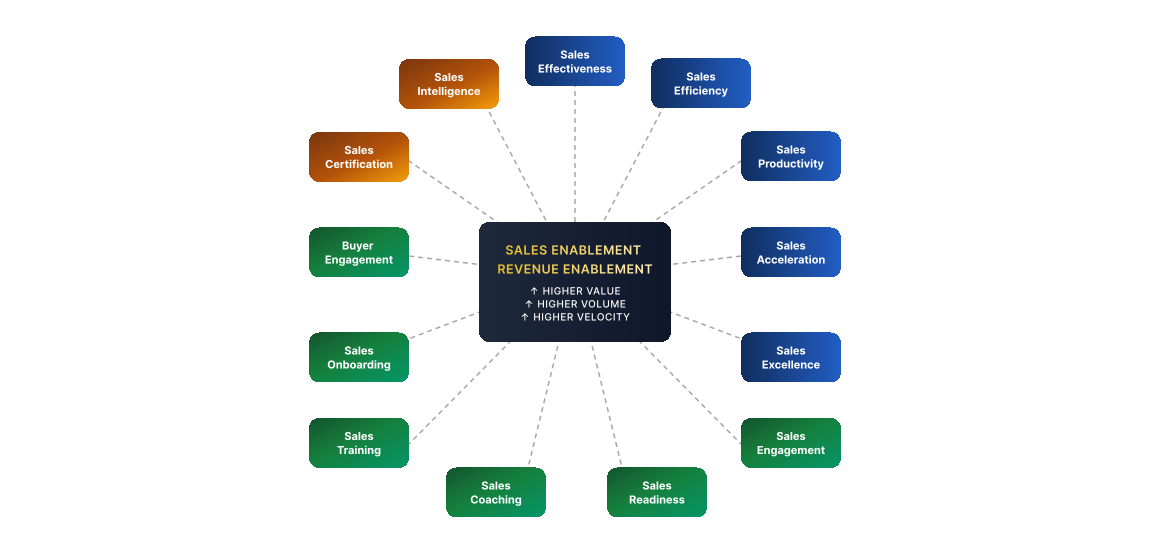
This is a diagnostic framework. When an organisation is underperforming on any of these sales / revenue dimensions, the fundamental starting question should be: Is the Sales Enablement infrastructure in place to support the required outcome? In almost every case, the answer to why Sales Readiness is low, why Sales Acceleration is stalling, or why Sales Excellence is inconsistent can be linked back to a gap in a functioning enablement system, or a lack thereof.
Sales vocabulary is the shared language that determines what an organisation actually builds, measures, and invests in. Getting the definitions right is the first step toward getting the interventions right. And the intervention that cuts across all sales terms — the one that connects every outcome to every team member to every process — is a functioning Sales Enablement / Revenue Enablement program. It describes and applies the same operating system to your sales, customer success and account management teams, as well as every other function in your company that owns some part of the customer relationship. SalesVault is built for all of them — one platform, one price, for every team that touches revenue.